 Menu
Menu
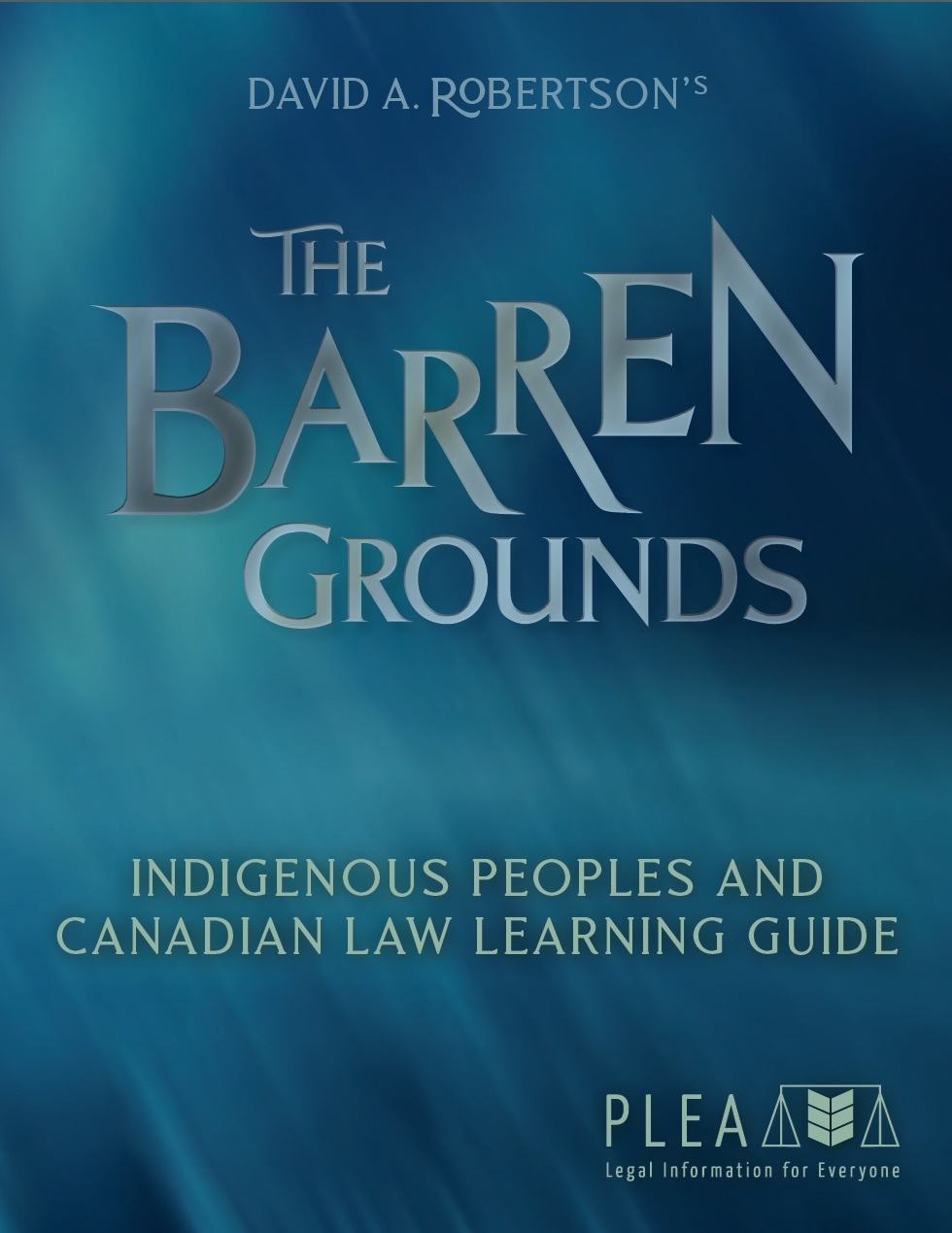
Saskatchewan’s English Language Arts 6 Curriculum asks that students Comprehend and Respond to a range of contemporary and traditional grade-level texts from First Nations, Métis, and other cultures. To help teachers fulfill this requirement, PLEA created David A. Robertson’s The Barren Grounds: Indigenous Peoples and Canadian Law Learning Guide.
The Barren Grounds, as described by the author, is
a middle-grade fantasy that is about two Cree foster children who discover a portal into another world called Askí, which is Cree for Earth. And they help the animal beings in that world, which has been cast into an eternal winter, find a way to save the world…. It’s an adventure story and it’s a journey of self-discovery.*
The popularity of The Barren Grounds with Grade 6 English Language Arts teachers is not surprising. Robertson’s brilliant adventure shines light on Indigenous Peoples and their cultures, all while linking to several Contexts and Suggested Themes of the ELA 6 Curriculum.
For example, The Barren Grounds can be used to approach Personal and Philosophical—Growing Up, with the self-discovery process experienced by the main character Morgan. It can be applied to Social, Cultural, and Historical—Going the Distance, with Morgan and her foster sibling Eli’s journey that brings them closer to their Indigenous roots. It can be employed for Imaginative andLiterary—Fantastic Fiction, given the novel’s world of Askí that lays beyond a magical portal in a Winnipeg attic. Or it can integrate Environmental and Technological—Space, Stars, and Quasars, with the ways it helps us understand the Indigenous stories of the night sky that have been neglected in favour of western stories about constellations.
Whatever the Context and Suggested Theme, The Barren Grounds is applicable to and popular with Grade 6 ELA programs. Hence, teachers are likely familiar with two learning resources for the book.
Tundra Books, the novel’s publisher, has created the brief but useful The Barren Grounds: Educator’s Guide. This resource includes valuable discussion questions and follow-up activities.
More substantial is the Alberta Professional Learning Consortium’s adaptation of a learning resource created by the Langley School District in British Columbia. The Barren Grounds: A Novel Study Unit, provides teachers with a comprehensive and culturally-informed approach to The Barren Grounds. It includes pre-reading and post-reading activities, alongside evaluation rubrics and supporting resources that connect to Indigenous worldviews and pedagogy.
PLEA’s David A. Robertson’s The Barren Grounds: Indigenous Peoples and Canadian Law Learning Guide does not attempt to replace these valuable works. Rather, our resource supports the Alberta Professional Learning Consortium’s work. It takes each of the Consortium resource’s thematic sections and integrates a law-related concept into the novel’s study, in a manner that supports Saskatchewan’s ELA 6 Curriculum. PLEA’s resource unfolds as follows:
Consortium Thematic Section - Law Connection
Section 1: Belonging - Child Welfare Laws
Section 2: Land & Place - Aboriginal Title/Treaty
Section 3: Responsibility - Hunting, Fishing, Trapping Rights
Section 4: Teachings - Indigenous Languages
Section 5: Community Consciousness - Self-Government
Section 6: Identity - United Nations Declaration on the Rights of Indigenous Peoples
For each section, PLEA has developed law-related background information for teachers. Also included is a slide to guide the discussion with students, alongside review questions and looking forward questions so that students can reflect upon what has been learned and think about what is yet to come.
For teachers interested in furthering their knowledge on the topics in this resource, or to learn more about Indigenous Peoples’ rights under Canadian law and Canadian laws that impact Indigenous communities, check out the all-new indigenous.plea.org. Information available includes Cree language videos.
On the whole, this resource will help students apply law-related knowledge to the book in specific and to the greater world in general, consistent with the Saskatchewan Ministry of
Education’s Broad Areas of Learning. Particularly, it will help “students learn about themselves, others, and the world around them” so that they may “make a difference in their personal, peer, family, and community lives.”
Teachers may wish to use one, a few, or even all of the elements of this PLEA resource as part of their approach to teaching The Barren Grounds.
In addition to this resource’s application to English Language Arts 6, Saskatchewan’s Social Studies 6 curriculum indicator IN6.1(f) invites teachers to use youth characters in literature to understand how culture and place influences youth. This resource thus can also be a helpful tool for building a cultural, historical, and legal cross-curricular English 6/Social Studies 6 unit of study.
Of course, no learning resource is perfect. Teachers are the people closest to the actual learning taking place in Saskatchewan classrooms. We welcome your feedback on this or
any other PLEA learning resource. Drop us a line with your thoughts and suggestions.
Full resource in PDF