 Menu
Menu
In the development of the postcard, most every country put their own stamp on it.
Germany’s reputation for cutting-edge manufacturing saw them become a leader in sophisticated postcard-printing techniques. France, known for its embrace of the fine arts, led the way in risqué but tasteful pin-up postcards.
Meanwhile in Britain, postcards took a funnier route. The British have a long history of ribald and smutty humour, from Shakespeare’s dirty jokes to Hogarth’s raucous satirical art. This history played out on British postcards, too. Postcards filled with colourful illustrations, lewd jokes, and wordplay became something of a national tradition, known as saucy seaside postcards.
Saucy seaside postcards appeared in the first years of the twentieth century and flourished up until the 1970s. These humorous and sometimes scandalous postcards could be found at shops in most every British seaside town, along with chain stores like Woolworths. Untold millions of cards were sold, created by artists often under pen names such as Comicus, Xerxes, Gomez, and S.H.
Britain’s most famous postcard artist, however, signed his real name: Donald McGill.
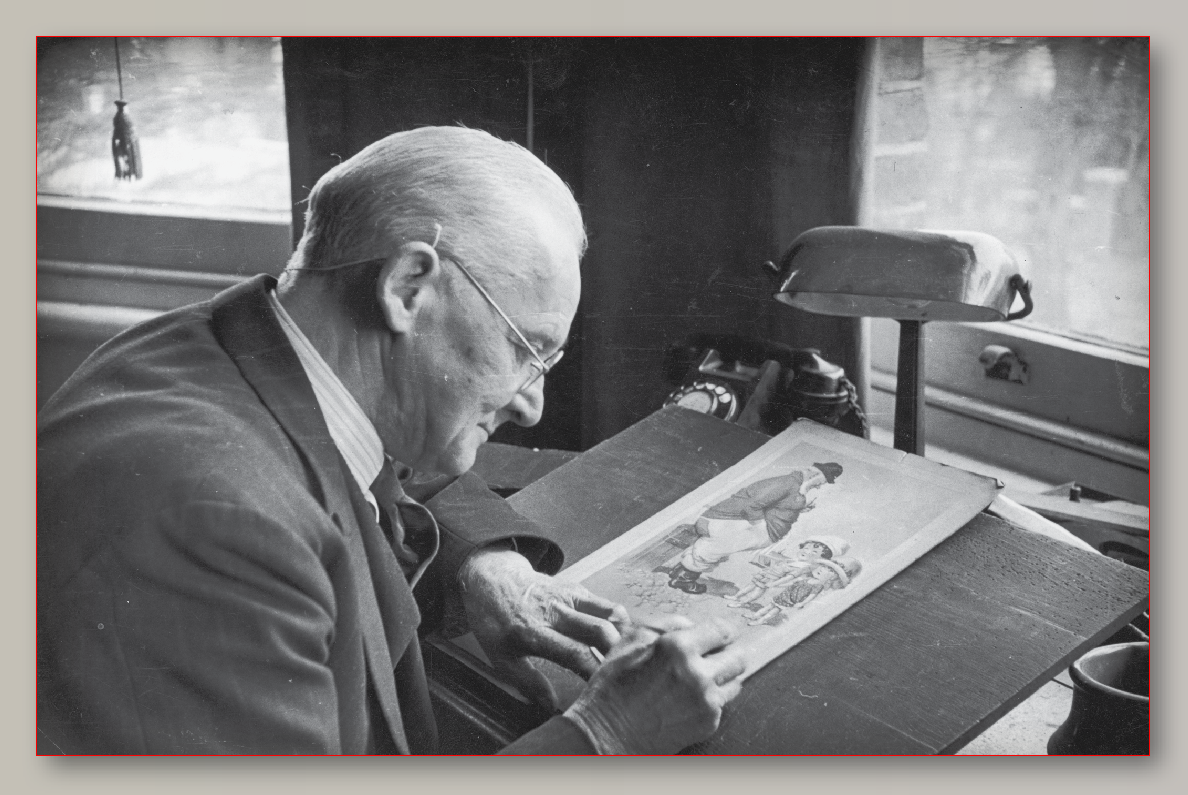
Donald McGill at work, 1951
Donald McGill’s lineage goes back to a prominent Canadian: he was the grandson of Peter McCutcheon, Montreal’s second mayor. McGill’s father John moved to England in 1859 and married Rosina Bisgood that summer. She gave birth to Donald in 1875 and raised him largely on her own, following John’s death in 1883.
McGill attended art school in 1891-1892, but dropped out because he liked drawing caricatures and the course didn’t allow for it. He resigned himself to a career of ship design, joining a naval architecture firm the following year and apprenticing as a draughtsman.
Pretty much by chance, his career path returned to art in 1904, thanks to a postcard he mailed to a sick nephew.
On the back of the postcard, McGill doodled a skater who had fallen through ice. He captioned it “Hope you’ll be out soon.” McGill’s brother and sister, who had connections to The Pictorial Postcard Company, loved the card. They hooked him up with the company’s owner, who offered McGill six shillings for the copyright to every card he created.
McGill thought drawing postcards would be a fun pastime
McGill thought drawing postcards would be a fun pastime. He accepted the offer with no idea that within four years, it would become his full-time job. McGill went on to create 12,000 cards.
In person, McGill was a modest man with a soft and cultured voice. You wouldn’t know it from his postcards. His art laughed at everything from married life to town drunks. Some jokes were original, some were stolen from music hall shows, some were lifted from chats at the pub. He would first decide upon the joke and then set to work creating a colourful drawing, ranging from plump and curvaceous women to red-nosed drunks to hunched-over seniors.
His wide appeal was due, in part, to avoiding partisan politics and sectarian humour. One exception was the suffragette movement. He supported women’s voting rights, yet his cards teased both sides of the issue. He also usually avoided jokes based on nationality and race, with the exception of the Scottish. McGill insisted as a Scot, he and his brethren were always ready to laugh at themselves.
McGill knew his work was a bit controversial
McGill knew his work was a bit controversial. While he enjoyed painting cards in the company of his children, he sometimes kept his occupation a bit dark with others, to protect his family’s image.
As years progressed, McGill’s cards became more popular. A big boost for McGill and postcards as a whole came when Britain passed the Holidays with Pay Act 1938. British seaside tourism boomed, because most everyone was now entitled to a paid week-off every year.
With Brits now flocking to seaside towns for getaways, a “What happens at the seaside stays at the seaside” mentality flourished. Particularly after World War II, an era of relative decadence set in. Seaside pubs, dance halls, cinemas, and live entertainment flourished. In lockstep, postcards became even more ribald. Countless publishers joined in creating “saucy” postcards.
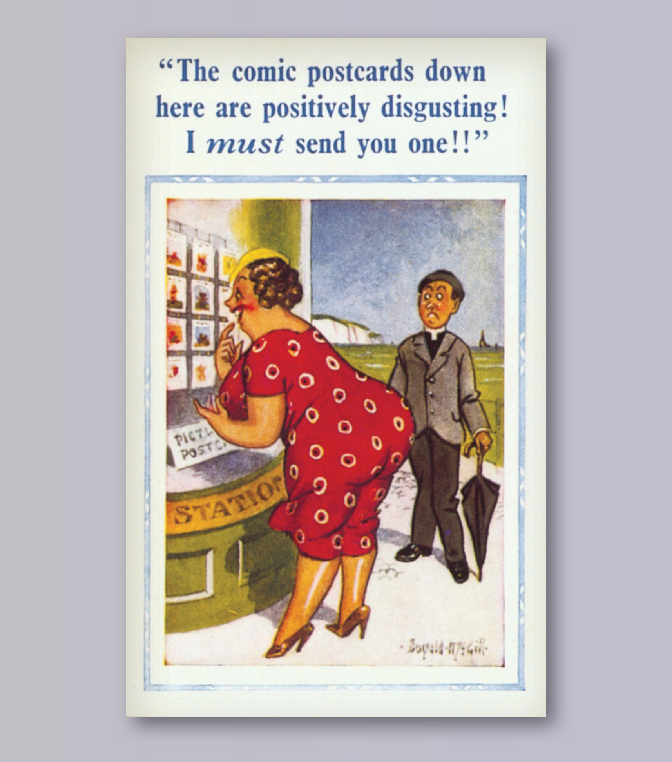
Donald McGill postcard, making fun of his own art
The ribaldry of these postcards did not go unnoticed. Local censorship committees popped up, and police raided shops for selling “obscene” postcards. McGill was even charged under Britain’s Obscene Publications Act 1857. We’ll talk more about this on the next page.
Towards the end of his life, McGill’s eyesight started to fail and his output slowed to only a few cards a week. He began to look back upon his art with a bit of regret. He told a television interviewer “I’m not proud of myself. I always wanted to do something better. I’m really a serious minded man underneath. I would have liked to have done sporting caricatures like Tom Webster or even oil paintings, if I’d had my way.”
Donald McGill passed away in 1963 at the age of 87, with very little money to show for his life’s work. He never signed royalty agreements for his art. Instead, McGill sold the copyright for each card he created to his publisher for a set fee. His estate was worth only 735, even though his postcards sold over 200 million copies.
Despite his self-doubt and lack of riches, McGill holds his own in the history of British art and British humour. His art built on the long English tradition of ribaldry and smut, a small museum on the Isle of Wight is dedicated to his life’s work, and because of his status as Britain’s premier saucy postcard creator, his original artwork can now fetch hundreds and sometimes even thousands of pounds at auction.
And it all began with a good-spirited get-well card to his nephew.