 Menu
Menu
It may be hard to comprehend today, but saucy seaside postcards didn’t just catch the attention of good-humoured holiday-makers in the first half of the twentieth century. Saucy seaside postcards caught the attention of the law.
Two years after Donald McGill began creating postcards, he received his first complaint. In 1906, a court in the north of England ordered a large quantity of a postcard titled “Our Boarding House” to be destroyed. It depicted a man waiting for a bath with a maid peering through a keyhole, saying “‘E wont be long now Sir, I can see ‘im adryin’ of ‘imself.”
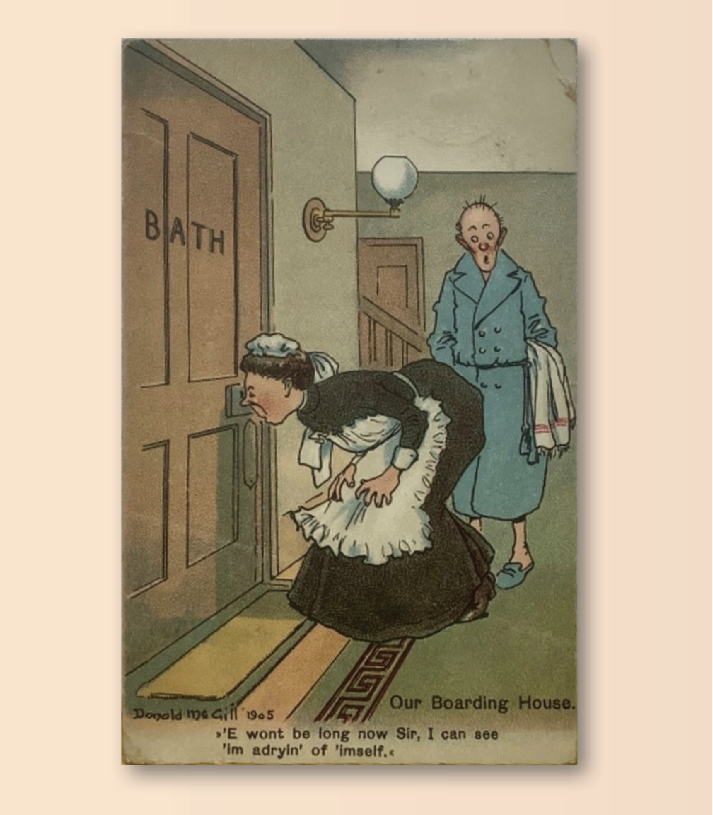
The first Donald McGill postcard to be banned by a local authority in England.
The case was a harbinger of things to come. Postcard censorship and corresponding trials picked up pace as saucy seaside postcards grew in popularity, gaining steam in the years following World War II.
Initially, censorship cases tended to be prompted by local complaints. Somebody would see a postcard in a shop, take offence to it, and report it to the police. If the police believed the postcard may be in contravention of a local law or the UK’s Obscene Publications Act, they would confiscate the cards and the shop owner would have to go to court to give reasons why the cards should not be destroyed.
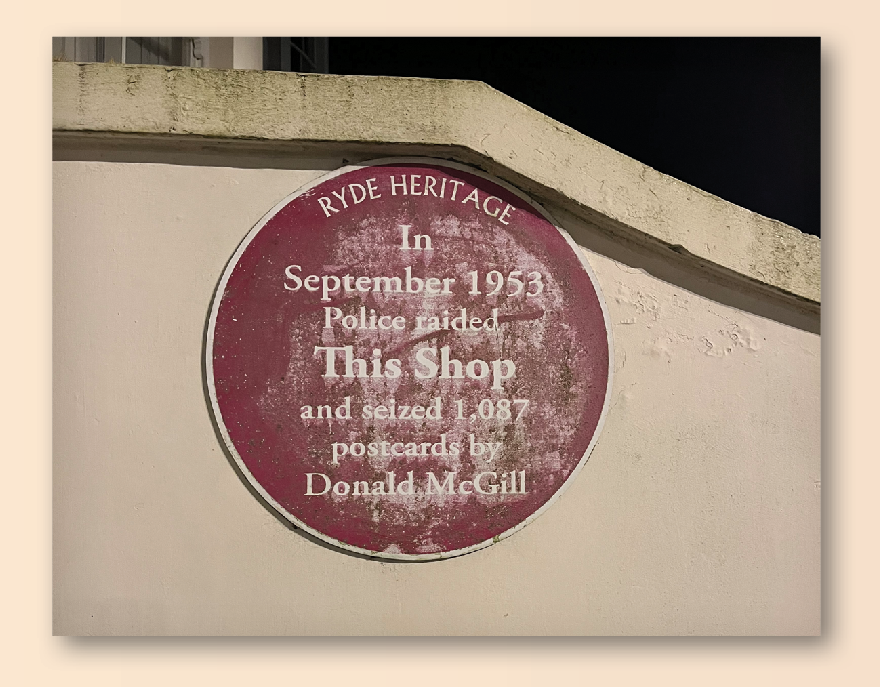
Plaque in Ryde, Isle of Wight, marking a 1953 police raid on a postcard seller’s seaside shop.
One such case took place in Hastings, a seaside town in southeast England. An evangelist, Douglas James Wellman, went store-to-store buying cards he found offensive. He turned them over to the police, who in-turn charged six shopkeepers under the Hastings Improvement Act 1885. The law had a section meant to protect citizens from sellers of obscene publications.
In court, Wellman testified that the postcards “filled me with indignation. I noticed one which was apparently meant to be funny. It was not; it was filthy.” Under cross-examination, the defence painted Wellman as someone who didn’t smoke or go to the theatre, who wouldn’t drink and objected to others being drunk, and who thought that jive dancing was immoral. The defence said the law was never meant to appease people like him, and he deliberately set out to get himself offended.
The court disagreed. They fined four of the six shopkeepers for being in contravention of the local act.
They fined four of the six shopkeepers for being in contravention of the local act
As more cases against shopkeepers mounted, the situation became more disorderly. Obscenities are difficult to define in a social context, let alone in law. The 1857 Act did not define obscenity, but instead left it to common law precedent. Courts relied on an 1859 case, R. v Hecklin, which ruled a publication to be obscene in law if it had a “tendency... to deprave and corrupt those whose minds are open to such immoral influences, and into whose hands a publication of this sort may fall.”
In practice, shopkeepers had no idea who would take offence to what.
To try to bring some order to the situation, local Chambers of Trade or Commerce began setting up Local Censorship Committees. These committees would preview cards and either approve or reject them for sale. The committees had no legal standing. Rather, they gave shopkeepers informal community acceptance to sell certain postcards. We think of this today as “social license.” Because social license has no statutory standing in law, shopkeepers were still at risk of prosecution.
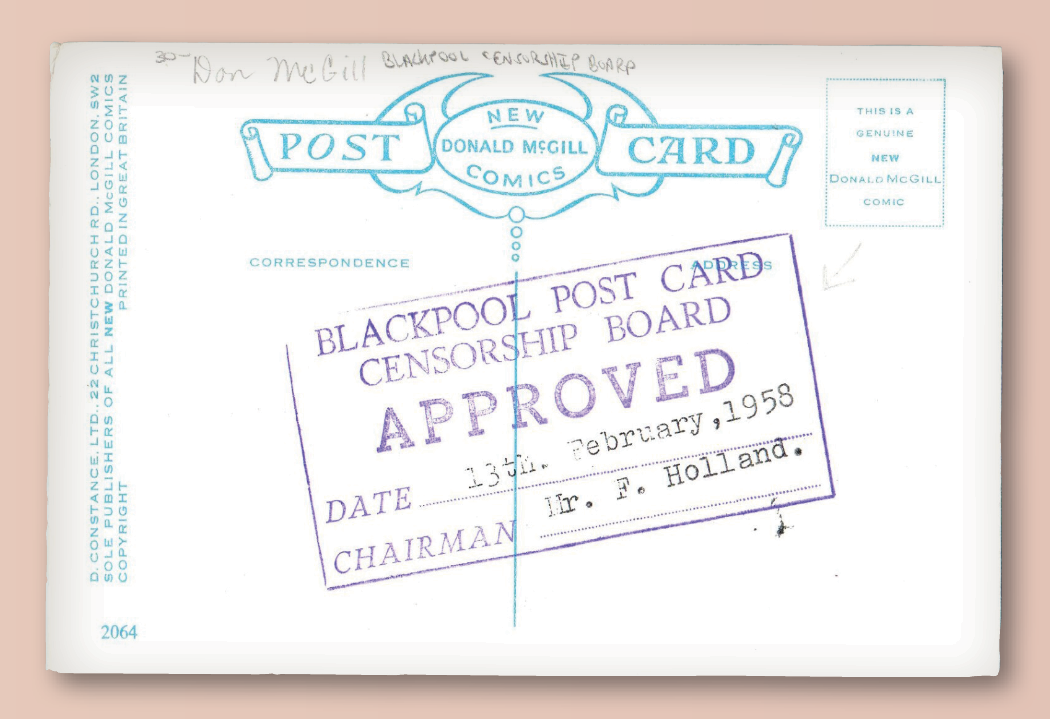
McGill postcard reviewed by the Blackpool Post Card Censorship Board. The board consisted of nine people: four trade representatives, four lay members from the community, and chairman F. Holland, a local bank manager.
Further complicating matters was that not every community had a committee, nor were these committees centrally coordinated. As a result, postcards deemed acceptable in one town were sometimes banned the next town over. Add to that, in towns without a committee pretty much any postcard could be for sale.
In the hopes of creating standards that would put shopkeepers at ease, postcard publishers lobbied the Association of Health and Pleasure Resorts, an organization representing over 100 British resort towns, to create a national system of postcard review. Those efforts failed.
Prosecutions only grew, perhaps spurred on by the election of a Conservative government in 1951. An estimated 11,662 postcards were ordered destroyed by local magistrates that year, increasing to 16,029 in 1952 and 32,603 in 1953. The Director of Public Prosecutions, Sir Theobald Mathew, began keeping records of what cards were prosecuted locally, with an eye to creating national guidelines.
The situation came to a head in 1953. Police raided 16 shops in Cleethorpes, a town in northeast England. When they discovered several cards for sale that had been taken in previous raids, Sir Mathew decided it was time to take prosecution to the next level: he charged the publishers under the Obscene Publications Act.
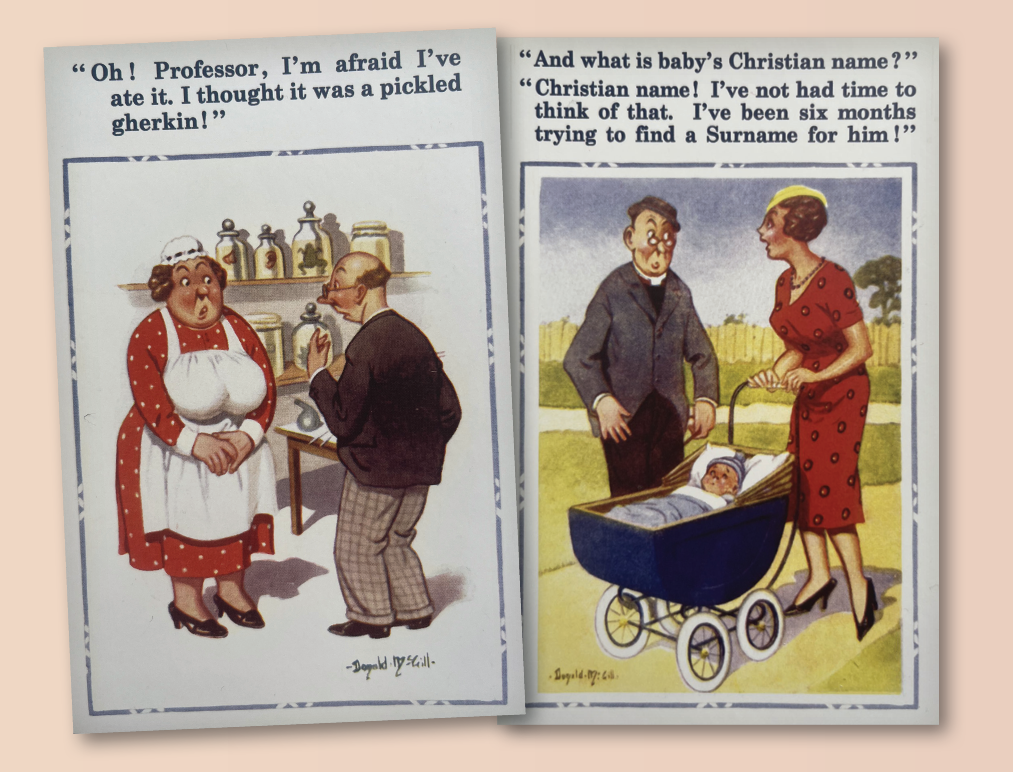
Left: Postcard from McGill’s 1954 trial. Responding to the obscenity charge, he submitted to the court that “There is nothing to indicate here what the woman had eaten. It might have been a thumb or a big toe. The prosecution have no right to put the worst construction on everything without evidence.”
Right: Postcard from McGill’s 1954 trial. Responding to the obscenity charge, he submitted to the court that “To say that there is any obscenity in suggesting—and suggesting only—that the girl had an illegitimate child is just ridiculous. That joke first appeared in the “Pink ‘Un” about 60 years ago.”
The high-profile trial unfolded in Lincoln in July 1954. In total, eight publishers were charged, and four publishers along with Donald McGill himself ultimately were tried in court.
The defence submitted examples from Shakespeare and Chaucer to demonstrate England’s long-standing tradition of smutty humour. McGill insisted that with many cards, he didn’t intend for them to be smutty. He wrote in a court brief:
I would desire to point out that in quite a number of cards in question I had no intention of ‘double meaning’ and, in fact, such was in some cases later pointed out to me, and I would also state that in my private life I have what might be called a Victorian outlook and do view with considerable criticism the modern trend of ‘sexual exposure’.
The court acquitted three of the four publishers. McGill and his publisher D. Constance, Ltd. weren’t so lucky. Their lawyer advised them to plead guilty with respect to four cards, and agree to not republish another 17. D. Constance, Ltd. was fined 50 plus 25 in costs, and McGill was fined 10.
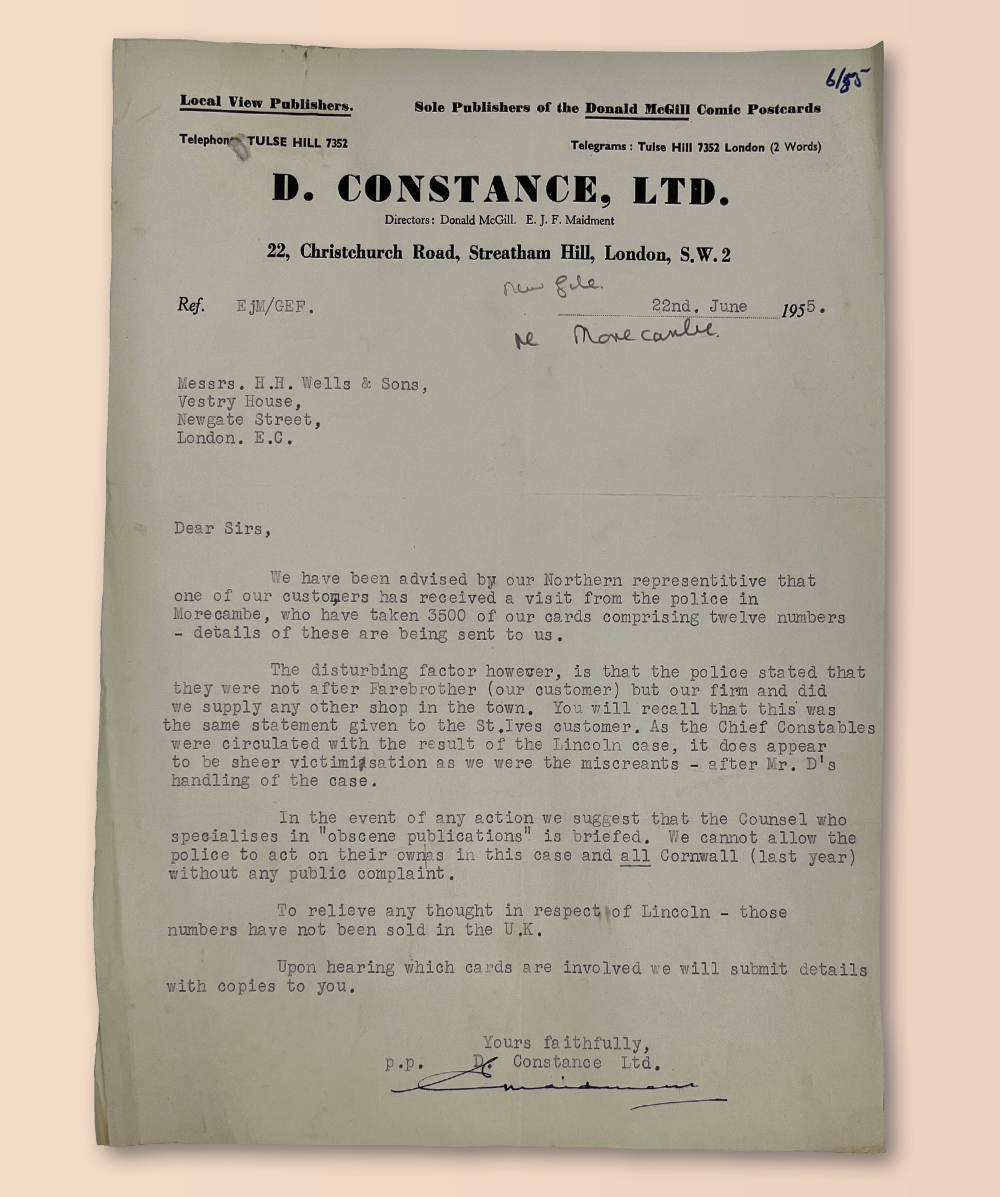
1955 letter from Donald McGill’s postcard publisher D. Constance, Ltd. to their solicitors, expressing alarm that police continue to pursue the company for publishing obscene postcards.
The case brought public attention not just to the issue of postcard censorship, but helped open public discussion about censorship in general and whether or not the century-old Obscene Publications Act was still fit-for-purpose.
The government, still Conservative, responded to the changing times. Parliamentary hearings were held, and in 1959 a new Obscene Publications Act was passed. The new act clarified the definition of obscenity, enshrined the right to bring forth expert testimony to speak to the artistic value of a work, specifically allowed for an artist’s intentions to be factored in when determining an obscenity, and added a “public good” defence to justify an obscene work if it had scientific, literary, or artistic merit.
The law’s first major test came the following year. Sir Mathew prosecuted Penguin Books for publishing D.H. Lawrence’s Lady Chatterley’s Lover, a book with sexual content, obscene language, and a class-defying affair. After only three hours of deliberation, the jury unanimously found Penguin not guilty. The acquittal is widely seen as a cultural turning point, paving the road in Britain for the more permissive 1960s.
The Department of Public Prosecutions stopped tracking postcards in 1962
With society and the law evolving, postcards in the 1960s evolved too. The Department of Public Prosecutions stopped tracking postcards in 1962, successful prosecutions of postcards dried up, and Local Censorship Committees began to wind down.
The changing times might be best-understood in light of the end of the Blackpool Censorship Committee. They disbanded in 1968, not long after a shop in Wales advertised for sale “Postcards Banned by the Blackpool Censorship Committee.”